
Research & Science
What grounding can make measurable in sport.
The research base points to relevant effects in endurance economy, lactate dynamics, recovery and autonomic stress regulation. Wirey translates this evidence into product and pilot concepts that are ready for brands.
Request researchExecutive summary
Four key areas of insight.
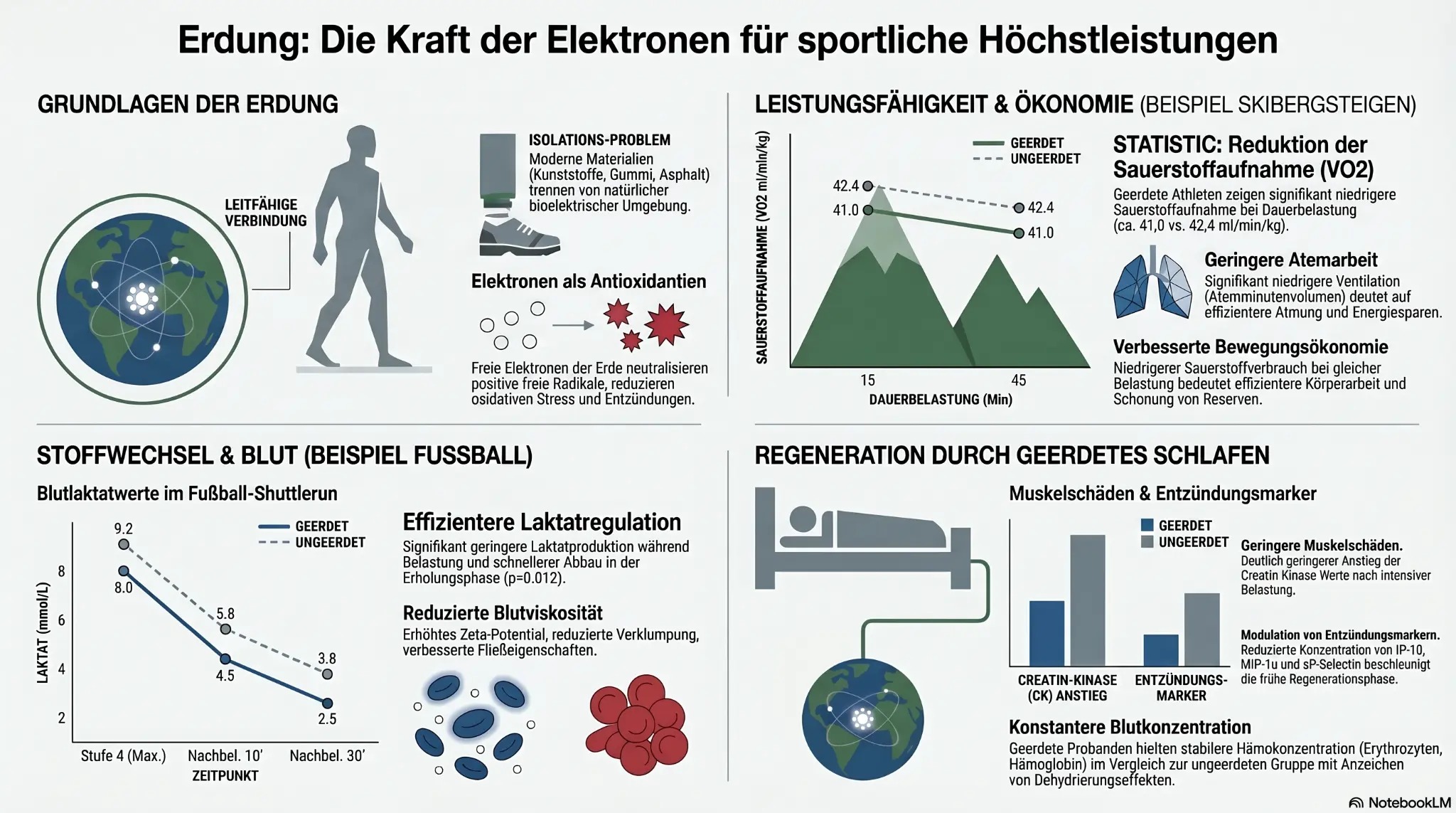
In ski mountaineering, lower oxygen uptake and ventilation at the same workload were observed in a laboratory setting. This is relevant for brands because this kind of movement economy describes an understandable performance benefit: the same work with potentially less physiological effort.
In a football context, a more favourable lactate dynamic was observed in a shuttle-run setting: lower lactate production during exertion and faster clearance during recovery. This opens up application ideas for sports involving repeated high-intensity exertion.
After eccentric exertion through downhill running, grounded sleeping was associated with less pronounced markers of muscle damage, more stable blood parameters and a modulated inflammatory response. This area is especially relevant for recovery products.
In addition, effects on the autonomic nervous system are described, such as improved heart-rate variability and lower skin conductance. These indications support the view of grounding as a potential interface between physical recovery and stress regulation.
Selected studies
A concise evidence overview.
| Setting | Key effect | Key statement |
|---|---|---|
| Ski mountaineering | Lower VO₂ and ventilation | At an identical workload, lower oxygen uptake and reduced breathing work were observed, indicating improved movement economy. |
| Football / shuttle run | Faster lactate clearance | Grounded participants showed lower lactate production during exertion and faster clearance during recovery. |
| Downhill running | Less muscle damage | Grounded sleeping was associated with a lower creatine-kinase increase, more stable haematological parameters and attenuated inflammatory markers. |
| Autonomic regulation | HRV and skin conductance | Indications of improved heart-rate variability and lower skin conductance suggest a potential effect on stress regulation. |
Mechanisms & hypotheses
Antioxidation, blood flow and energy processes.
The discussed mechanisms include an antioxidant effect of free electrons, improved blood viscosity through the zeta potential of red blood cells and the hypothesis of an interaction with the mitochondrial electron transport chain. For professional communication, it is important to distinguish clearly between established observations and hypotheses.
Practical implications for brands.
Brands can integrate grounding technology into categories such as socks, footwear, liners, sleeves, sleep pads, recovery mats or training-centre solutions. The decisive factor is the combination of conductive construction, a clear use case, a measurable target and credible communication.